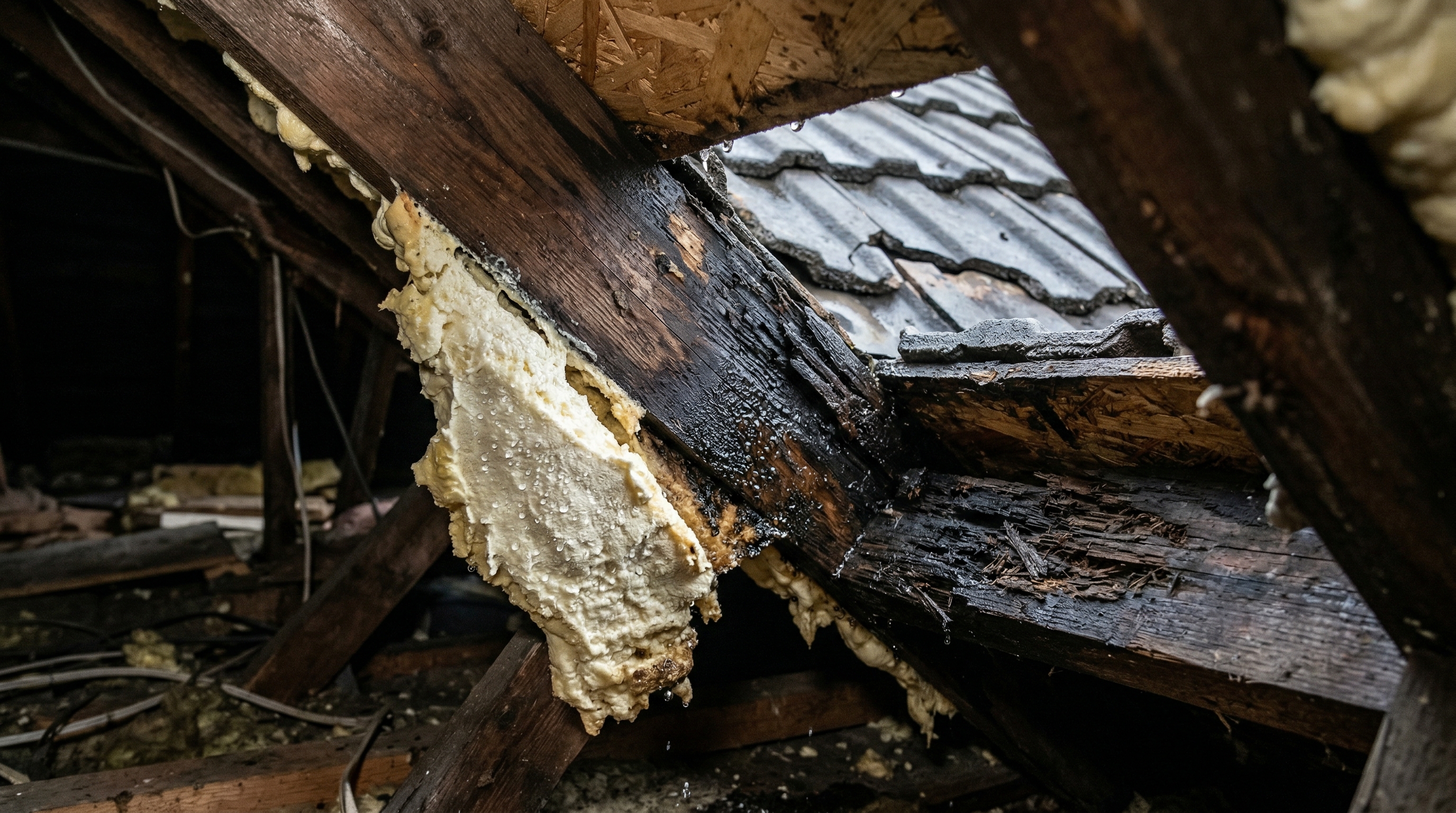

One of the most insidious consequences of spray foam insulation in UK roofs is the hidden timber rot it causes. Because the foam conceals the very timbers it's damaging, homeowners often have no idea their roof structure is decaying until a mortgage survey reveals the problem — or until structural failure becomes imminent.
How Spray Foam Causes Timber Rot
The mechanism is straightforward but devastating:
- Moisture enters the loft space — warm, moist air from the living space below rises naturally through gaps around the loft hatch, downlights, pipe penetrations, and ceiling junctions
- Spray foam traps the moisture — the foam seals the roof's natural ventilation pathways, preventing moisture from escaping through the ridge and eaves
- Condensation forms — moisture condenses on cold surfaces behind and around the foam, particularly during cold weather
- Timber absorbs moisture — roof timbers (rafters, purlins, ridge boards) absorb the condensation, raising their moisture content
- Rot fungi colonise — when timber moisture content exceeds 20%, wood rot fungi can establish and begin breaking down the wood
- Damage progresses invisibly — the spray foam conceals the rotting timber, preventing early detection
Types of Rot Found Behind Spray Foam
Wet Rot
Wet rot is the most common type found behind spray foam. It requires consistently high moisture levels (above 50%) and manifests as:
- Soft, spongy timber that crumbles when prodded
- Dark brown or black discolouration
- Cracking along the grain of the wood
- Musty, damp smell
Dry Rot
More dangerous and harder to treat, dry rot can spread beyond the original moisture source. Signs include:
- Red-brown spore dust on surfaces
- White cotton-wool-like mycelium (fungal strands)
- Mushroom-like fruiting bodies in advanced cases
- Timber that cracks into cube-shaped pieces (cuboidal fracture)
Dry rot can spread through masonry and affect timber well beyond the original damp area, potentially threatening the structural integrity of the entire roof.
Why Is This a Hidden Danger?
The danger is "hidden" because:
- The foam conceals everything — you cannot see the timber condition through spray foam
- Early signs are invisible — rot begins on the surfaces in contact with the foam, hidden from view
- Symptoms appear late — by the time you notice damp patches on ceilings or musty smells, the rot may be extensive
- Surveyors cannot inspect — RICS surveyors specifically flag that they cannot assess timber condition behind spray foam
Warning Signs of Hidden Timber Rot
Even though the foam conceals the damage, there are warning signs to watch for:
- Damp patches on bedroom ceilings — particularly in cold weather
- Musty smells in the loft — even faint, persistent damp odours are significant
- Soft timber at foam edges — press exposed timber at the boundary of the foam; if it gives or feels spongy, rot is likely present behind the foam
- Dark staining — moisture marks or dark discolouration on any visible timber
- Mould growth — any visible mould on surfaces in the loft space
- Sagging roofline — visible from outside, indicating structural timber may be failing
What Happens If Rot Is Left Untreated?
Ignoring timber rot behind spray foam leads to escalating problems:
- Progressive structural weakening — rafters lose load-bearing capacity as rot advances
- Spread to adjacent timbers — rot fungi spread from affected to healthy timbers
- Roof sagging — visible deformation of the roofline as timbers fail
- Water ingress — weakened roof structure allows rain penetration
- Exponentially increasing repair costs — what starts as a £500 treatment can become a £10,000+ structural rebuild if left
The Solution: Professional Removal and Timber Assessment
The only way to properly address hidden timber rot behind spray foam is to:
- Remove all spray foam — exposing the full roof structure for inspection (learn about the removal process)
- Assess timber condition — a thorough inspection of all timbers, testing moisture content and structural integrity
- Treat or replace damaged timber — applying preservatives, splicing new timber, or replacing sections as needed
- Restore ventilation — ensuring eave-to-ridge airflow is fully restored
- Obtain certification — a removal certificate confirming the roof is sound
The cost of spray foam removal is a fraction of the repair bill if rot is allowed to progress to structural failure. Request your free assessment today.