
If you're trying to sell, remortgage, or buy a property with spray foam insulation in the loft, you've likely hit a brick wall with mortgage lenders. Across the UK, an increasing number of homeowners are discovering that spray foam insulation makes their property effectively unmortgageable.
This isn't a minor inconvenience — it's a crisis affecting thousands of UK homeowners who were sold spray foam as an energy-saving solution, only to find it's now the single biggest barrier to selling or remortgaging their home.
Why Do Mortgage Lenders Refuse Properties With Spray Foam?
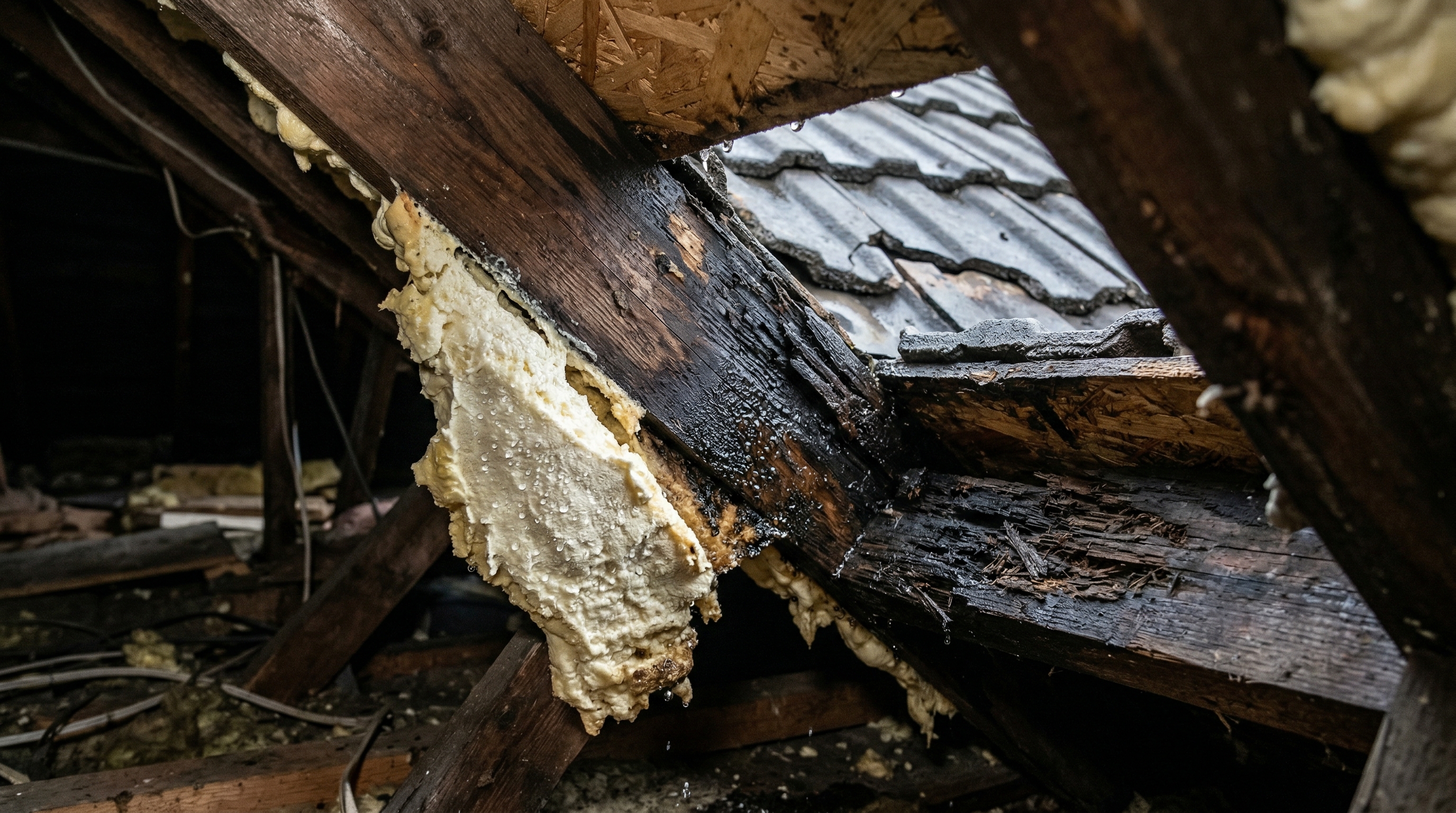
Mortgage lenders rely on RICS-qualified surveyors to assess a property's condition and value before approving a loan. When spray foam insulation is present, surveyors cannot properly inspect the roof structure — the foam conceals the very timbers, tiles, and membranes they need to examine.
The key concerns lenders have include:
- Hidden structural defects — spray foam masks rot, woodworm, and timber decay that would otherwise be visible during a survey
- Moisture trapping — closed-cell spray foam prevents natural ventilation, trapping condensation against roof timbers and accelerating decay
- Tile adhesion — foam bonded to roof tiles prevents individual tile replacement, turning a simple repair into a full roof strip
- Unknown long-term effects — spray foam insulation has only been widely used for 10-15 years, and the long-term impact on UK roof structures is still emerging
- Removal cost liability — lenders factor in the potential £3,000-£8,000 removal cost as a risk to the property's security value
Which UK Mortgage Lenders Refuse Spray Foam Properties?
The list of lenders with restrictive policies on spray foam is extensive and growing:
Major High Street Lenders
- Halifax — will not lend on properties with spray foam applied to roof timbers or underside of tiles
- Barclays — requires spray foam to be removed before mortgage approval
- HSBC — refuses lending where spray foam prevents adequate roof inspection
- Nationwide — decline applications where surveys flag spray foam concerns
- NatWest/RBS — restrict lending pending removal and re-inspection
- Santander — will not proceed where spray foam is identified in survey
What About Specialist Lenders?
Some specialist and buy-to-let lenders may consider properties with spray foam on a case-by-case basis, but typically at higher interest rates and with additional survey requirements. This is not a practical long-term solution for most homeowners.
The Impact on Property Value and Saleability
The mortgage lending restrictions create a devastating chain reaction for homeowners:
- Buyers can't get mortgages — eliminating 85%+ of potential purchasers who need lending
- Cash buyers demand huge discounts — knowing they hold all the negotiating power
- Surveyors down-value properties — reflecting the risk and removal costs
- Chains collapse — when spray foam is discovered mid-transaction
Estate agents across the UK report that properties with spray foam typically sell for 10-20% below market value, if they sell at all. Many remain on the market for months or years until the homeowner agrees to removal.
How Professional Spray Foam Removal Solves the Problem
The good news is that this is a fixable problem. Professional spray foam removal followed by proper certification restores your property to full mortgageability.
The process works as follows:
- Assessment — a specialist removal company surveys your loft to determine the type and extent of spray foam
- Removal — trained technicians carefully remove all spray foam without damaging roof timbers or tiles
- Inspection — the exposed roof structure is inspected for any underlying damage
- Certification — a post-removal certificate is issued confirming complete removal and structural integrity
- Re-survey — your property can now be surveyed normally, unlocking standard mortgage products
What to Do If Your Property Has Spray Foam
If you're facing mortgage problems due to spray foam insulation, take these steps immediately:
- Don't panic — thousands of UK homeowners have successfully resolved this issue through professional removal
- Get a removal quote — understand the costs involved (typical costs range from £3,000 to £8,000)
- Inform your estate agent or solicitor — transparency speeds up the resolution process
- Choose a certified removal company — ensure they provide post-removal certificates accepted by lenders
- Keep documentation — photographs, certificates, and reports will be needed for future surveys
If you're concerned about roof problems caused by spray foam, or want to understand the health implications, our other guides cover these topics in detail.
Can You Claim Compensation for Spray Foam Installation?
Some homeowners may have grounds to pursue the original installer for compensation, particularly if:
- The spray foam was mis-sold without adequate warnings about mortgage implications
- The installation was carried out poorly, causing additional damage
- Guarantees or warranties provided are not being honoured
- The installer made claims about mortgageability that proved false
We recommend seeking legal advice if you believe you were mis-sold spray foam insulation. However, pursuing compensation should not delay removal — the longer spray foam remains, the greater the risk of timber damage.
The Bottom Line
Spray foam insulation and mortgages simply don't mix in the current UK property market. If your property has spray foam, professional removal is almost certainly the most cost-effective path forward — protecting your property value, restoring mortgageability, and giving you peace of mind about the condition of your roof structure.
Request a free spray foam removal quote today and take the first step toward resolving your mortgage problem.