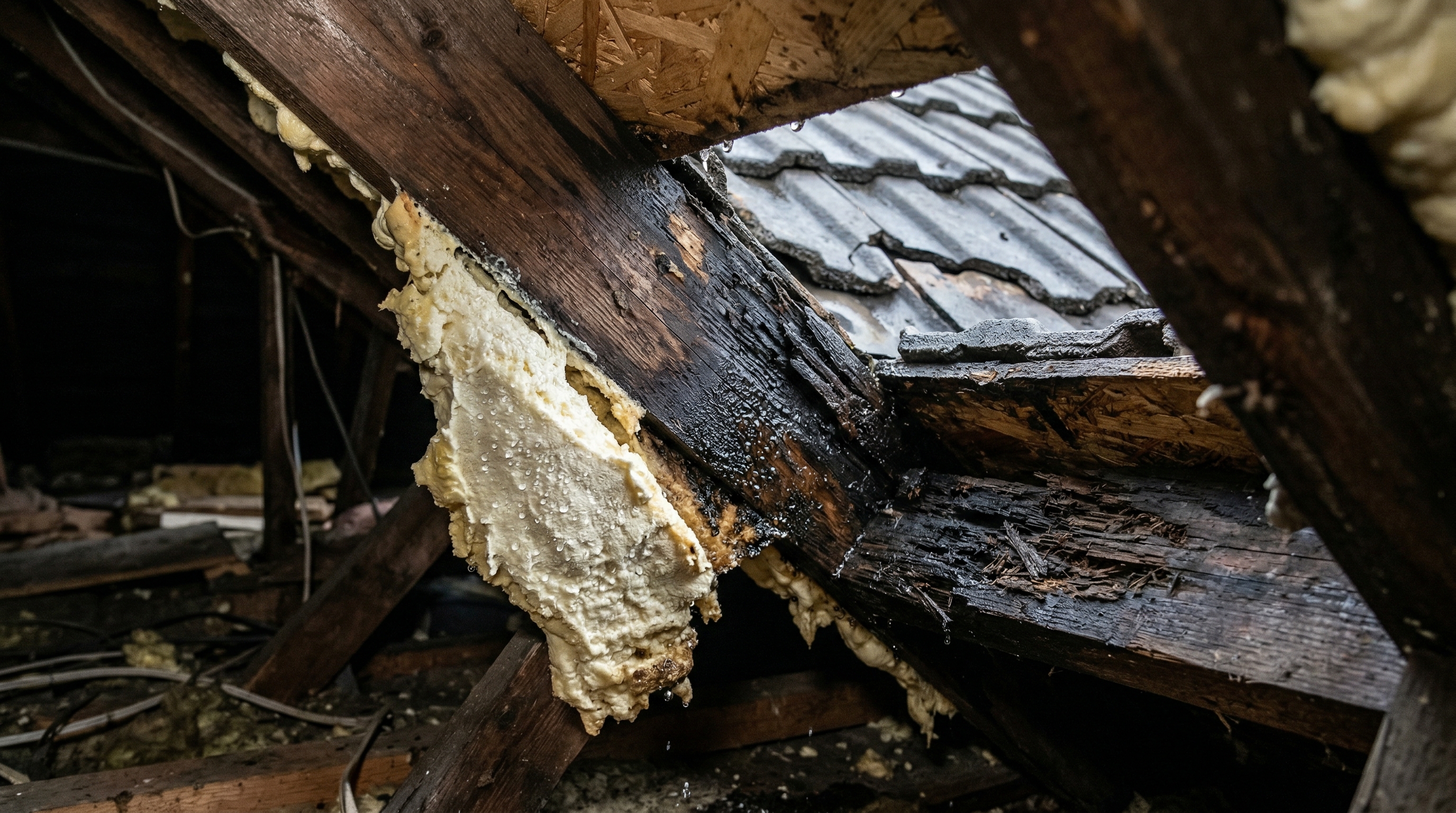

Not all spray foam insulation is created equal — and understanding the difference between open cell and closed cell spray foam is crucial if you're dealing with insulation problems in your UK home. Each type behaves differently, causes different problems, and requires different removal approaches.
Whether you're trying to resolve a mortgage problem, investigating roof damage, or simply trying to understand what's in your loft, this guide explains everything you need to know.
What Is Open Cell Spray Foam?
Open cell spray foam (sometimes called half-pound foam) is the softer, lighter variety of spray foam insulation. Its key characteristics include:
- Density — approximately 8-12 kg/m³ (much lighter than closed cell)
- Texture — spongy and flexible, similar to a bath sponge
- Vapour permeability — allows some moisture to pass through
- Thermal performance — R-value of approximately 3.5-3.7 per inch
- Expansion — expands roughly 100x during application
- Colour — typically light yellow or cream
What Is Closed Cell Spray Foam?
Closed cell spray foam (two-pound foam) is the rigid, dense variety that causes the most serious problems in UK roofs:
- Density — approximately 28-55 kg/m³ (3-5x heavier than open cell)
- Texture — hard and rigid, similar to hard plastic
- Vapour permeability — virtually impermeable — acts as a complete vapour barrier
- Thermal performance — R-value of approximately 6.0-6.5 per inch
- Expansion — expands roughly 30-40x during application
- Colour — typically yellow, green, or off-white
Problems Caused by Each Type
Open Cell Spray Foam Problems
While open cell foam is generally less destructive, it still causes significant issues:
- Condensation — if installed without adequate ventilation, moisture can accumulate within and behind the foam
- Survey obstruction — still prevents surveyors from inspecting roof timbers, triggering mortgage lending refusals
- Water absorption — open cell foam can absorb water like a sponge if roof leaks occur, hiding the leak while causing extensive timber damage
- Sagging — can sag or detach from surfaces over time, especially in humid conditions
Closed Cell Spray Foam Problems
Closed cell foam poses more severe and costly problems:
- Tile adhesion — bonds permanently to roof tiles, making individual tile replacement impossible without stripping large sections
- Moisture trapping — creates a complete vapour barrier that traps condensation against cold surfaces, accelerating timber rot
- Structural stress — the rigid foam can prevent natural timber movement, causing stress fractures in older roof structures
- Removal damage — the strong bond means removal risks damaging tiles, battens, and even rafters
- Higher removal costs — requires more time, labour, and specialist equipment to remove safely
How to Identify Which Type You Have
You can usually identify the type of spray foam in your loft with a simple test:
- Press test — push your finger into the foam. If it compresses easily like a sponge, it's open cell. If it's hard and rigid, it's closed cell.
- Visual check — open cell foam is typically lighter in colour and has a more uniform, spongy appearance. Closed cell foam looks denser and may have a slight sheen.
- Thickness — open cell foam is usually applied thicker (75-150mm) because of its lower insulating value per inch. Closed cell foam is applied thinner (25-50mm).
Removal Process: Open Cell vs Closed Cell
Open Cell Removal
Open cell foam removal is relatively straightforward compared to closed cell:
- Can often be peeled or scraped away from surfaces
- Less risk of damage to underlying tiles and timbers
- Typically takes 2-4 days for a standard loft
- Cost: typically £2,500-£5,000
Closed Cell Removal
Closed cell foam removal is significantly more challenging:
- Requires mechanical removal tools and careful technique
- Higher risk of tile and timber damage during removal
- Typically takes 3-6 days for a standard loft
- Cost: typically £4,000-£8,000 or more
Which Type Is Worse for UK Homes?
In the context of UK housing and climate, closed cell spray foam causes more severe and costly problems. The UK's damp, temperate climate means roofs need to breathe — closed cell foam's complete vapour barrier works directly against this requirement.
However, both types will trigger mortgage lending refusals, and both should be professionally removed if you need to sell your property or obtain certification for lending purposes.
If you're unsure which type of spray foam is in your loft, or need advice on removal, request a free assessment from our certified removal specialists.
Removal certificate that lenders trust
Regardless of foam type, every removal we carry out is independently signed off by a RICS surveyor. We are the only removal service in the UK that provides this as standard. Other companies issue their own certificates — ours are independently verified. That matters when your mortgage application depends on the certificate being accepted.