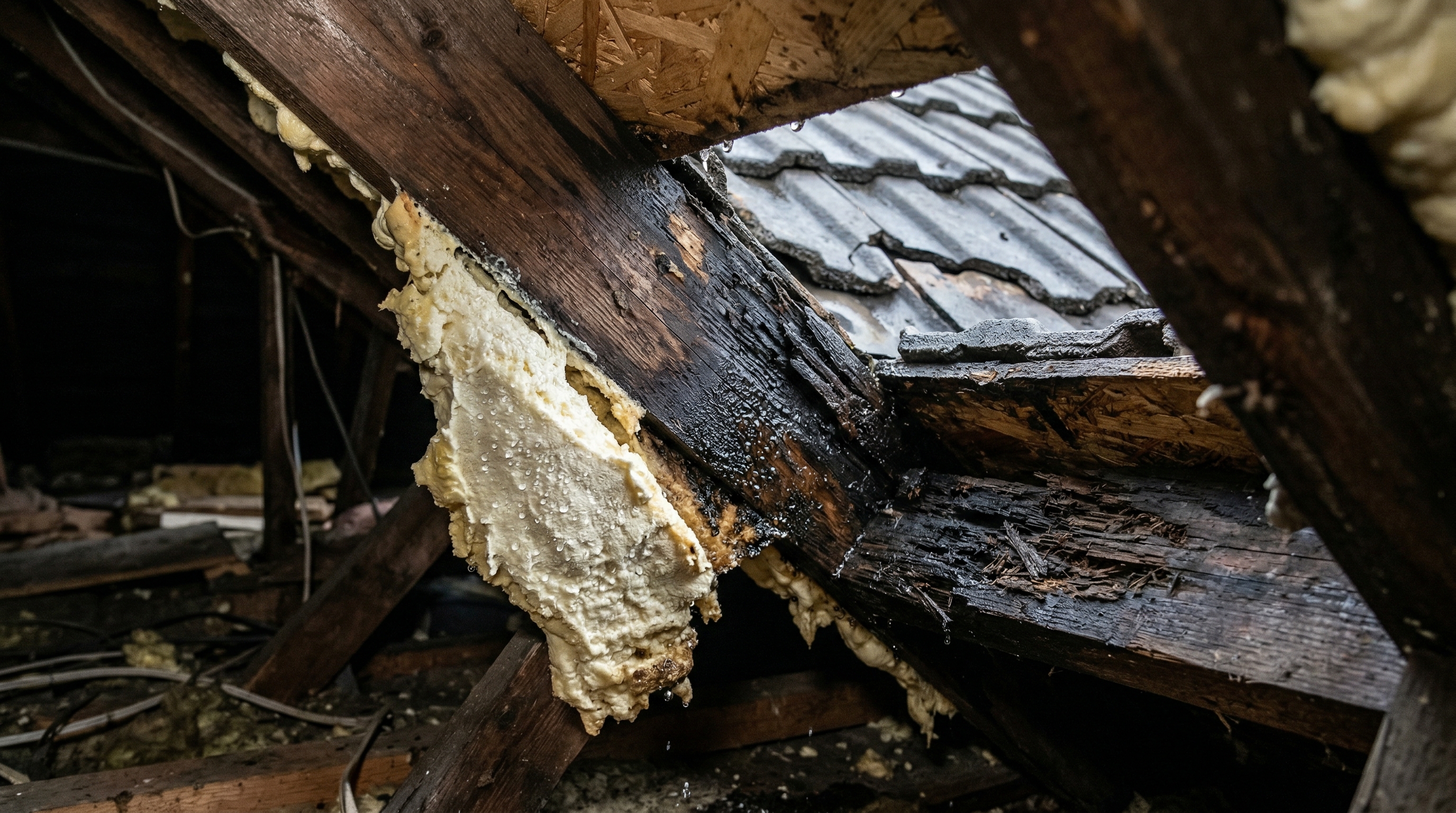

Almost every quote you receive for spray foam removal will be built from a rate per square metre, then multiplied by your roof area. Understanding that one number is what lets you compare three quotes properly instead of just picking the cheapest.
Spray foam removal costs £50-80 per square metre in the UK. Open-cell foam sits at the lower end, around £50-65/m². Closed-cell sits at the top, around £65-80/m², because it is denser and bonds harder to the roof timbers. For most properties that works out at a total of £3,000-£8,500.
Why removal is priced per square metre
Removal is almost entirely labour. Somebody is in your loft, in protective equipment, working foam off rafters by hand with scrapers and blades. There is no machine that does this quickly, and there is no chemical shortcut that a mortgage lender will accept afterwards.
Because the cost is labour and labour scales with area, a rate per square metre is genuinely the fairest way to price it. A quote given as a flat figure without reference to your roof area is a quote somebody has guessed.
What your roof area actually is
This is where most confusion starts. The figure that matters is the area covered by foam, not your floor area and not your total roof area.
Foam is usually applied to the underside of the pitched roof, so the covered area is the sloping surface, which is larger than the footprint beneath it. As a rough guide:
| Property | Typical foam-covered area | At £50-80/m² |
|---|---|---|
| Small terrace, or partial coverage | 40-60 m² | £2,000-£4,800 |
| Three-bed semi-detached | 60-90 m² | £3,000-£7,200 |
| Large or detached | 90-110 m² | £4,500-£8,800 |
Two things to take from that table. First, a genuinely small or partially covered loft can come in under £3,000 — the £3,000-£8,500 range describes typical whole-property jobs, not every possible job. Second, the arithmetic should always work: if a quote gives you both a rate and a total, multiply them and check they agree. Surprisingly often they do not.
Open-cell versus closed-cell
| Open-cell | Closed-cell | |
|---|---|---|
| Removal rate | £50-65/m² | £65-80/m² |
| Texture | Softer, sponge-like | Dense, rigid |
| Why it costs what it does | Comes away in larger pieces | Bonded hard to timber, removed in fragments |
If you do not know which you have, a specialist will tell you on a survey visit, and it is worth knowing before you accept a quote — being charged the closed-cell rate for open-cell foam is one of the easier ways to overpay.
What should already be in the rate
A per-square-metre rate is only comparable if the quotes include the same things. Through our network, these are included as standard rather than added later:
- Full mechanical removal by hand
- Loft ladder access and floor protection
- Post-removal cleaning and vacuuming
- Photographic evidence of the exposed timbers
- Removal and condition report
- Removal certificate for your mortgage lender
Ask explicitly whether each of those is in the number you have been given. The gap between a cheap quote and a fair one is usually not the rate — it is what the rate excludes.
What is genuinely extra
Some things are not padding, and a quote that pretends otherwise is not being straight with you:
- Timber repairs. Nobody can price these until the foam is off and the wood is visible. Expect them to be quoted separately, and be suspicious of a fixed price offered before anyone has seen the rafters.
- Re-insulation. Optional, and cheap by comparison — mineral wool is roughly £5-15/m² fitted.
- Waste disposal. Should be a fixed, stated fee rather than a variable.
- Scaffolding, only where access genuinely requires it.
How long it takes
Most three-bedroom properties take 2-5 days, depending on roof complexity, foam type and access. Closed-cell takes longer than open-cell. Timber repairs, where needed, add time beyond that.
A quote promising a large closed-cell roof stripped in a single day is either understaffing the job or planning to leave residue, and residue is what causes the certificate to fail.
Reading a quote properly
Three questions settle most of it:
- What rate per square metre, and what area have you measured? If they have not measured, they have not quoted.
- Is the removal certificate included? This is the document your lender reads. It should not be an upsell.
- What happens if the timbers are damaged? You want the answer to be "we stop, show you, and quote separately" — not silence.
If a domestic quote lands well above £8,500 without a specific written reason — unusual roof area, damage already identified — get a second opinion. Equally, a quote far below £50/m² usually means chemical or thermal removal, or a partial strip, and neither reliably satisfies a lender.
Frequently asked questions
How much is spray foam removal per square metre in the UK?
£50-80 per square metre. Open-cell is typically £50-65/m² and closed-cell £65-80/m², because closed-cell is denser and bonds harder to the timber. Most whole-property jobs total £3,000-£8,500.
Is the rate based on floor area or roof area?
The area actually covered by foam, which is usually the sloping underside of the roof. That is larger than the floor beneath it, so a quote based on your floor area will understate the job.
Why is closed-cell more expensive to remove?
It is denser and adheres more strongly to the roof timbers, so it has to be worked off in smaller fragments. The difference is entirely labour time.
Does the per-square-metre rate include the certificate?
It should. Through our partner network the removal certificate and condition report are standard rather than extras. Always confirm, because it is the document a mortgage lender actually asks for.
Can I reduce the cost by doing part of it myself?
In practice, no. Partial or DIY removal tends to leave residue on the timbers, and a surveyor who cannot see clean wood cannot sign the certificate — so the work gets done twice. It is the most expensive way to save money on this job.