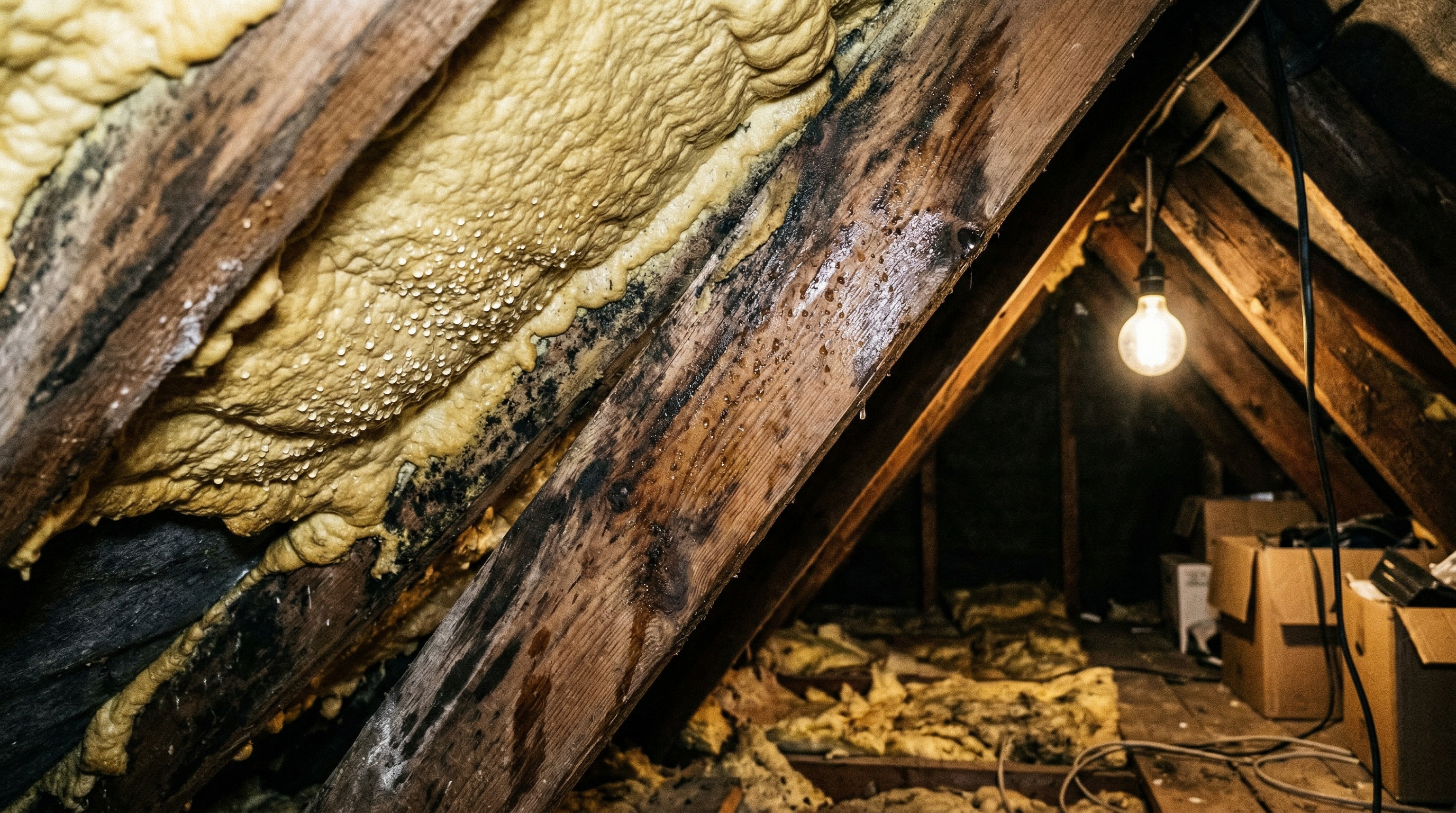
Why roofs and spray foam do not mix
Spray foam was marketed as the perfect loft insulation — applied directly to the underside of the roof, it seals every gap and keeps heat in. That part is true. The problem is everything that happens next.
A roof needs to breathe. Moisture from inside the house, rain that drives under tiles, seasonal temperature changes — all of these produce water vapour that needs somewhere to go. In a properly ventilated roof, air moves in through the soffit vents, travels along the underside of the tiles, and exits through ridge vents. The timber stays dry. The roof works as designed.
Spray foam stops this dead. It seals the underside of the roof into an airtight barrier. Moisture that would normally escape is now trapped, and it accumulates on surfaces that were never designed to be wet.
Condensation: the problem you do not see until it is serious
Condensation behind spray foam is the most common issue we deal with. Warm air from the house meets the cold surface behind the foam and water forms. In a ventilated loft, this evaporates. With foam in the way, it pools.
The water sits against the timber. For months. Sometimes years. By the time anyone checks — usually because they are selling and a surveyor flags the foam — the damage can be extensive.
What we typically find during inspections:
- Blackened timber: The most common sign. Rafters that should be a clean, dry wood colour are dark and stained. The discolouration is usually wet rot working its way through the surface layers.
- Soft spots in the wood: Press a screwdriver into the rafter and it sinks in. The timber has lost structural integrity in those areas. This is not cosmetic — it means the rafter is failing.
- Water pooling at the wall plate: Condensation runs down and collects where the rafters meet the top of the wall. This is one of the worst locations for water damage because it affects the structural connection between roof and wall.
- Mould growth: Where moisture persists, mould follows. We have opened up loft spaces where the foam was growing black mould on its inner surface, directly against the timber.
A note about open-cell vs closed-cell: Open-cell foam absorbs moisture and holds it against the wood like a wet sponge. Closed-cell foam does not absorb water in the same way, but it creates an even tighter seal, so any moisture that does get behind it has no escape route at all. Both types cause condensation problems. Neither is safe from a structural perspective.
Roof tile and felt damage
Spray foam bonds to whatever it touches — tiles, battens, sarking felt, rafters. When it bonds to the underside of tiles, those tiles can no longer move independently. Roofs are designed with some flexibility. Tiles shift slightly in wind, expand and contract with temperature changes, and settle over time. Once they are glued in place by foam, that flexibility is gone.
The result is cracked tiles. We see this regularly on older properties where the tiles have been in place for decades without issue, then start cracking within a few years of foam being applied. Replacing individual tiles becomes more difficult too, because each tile is bonded to the foam which is bonded to the batten which is bonded to more foam.
Roof felt gets damaged in a similar way. Breathable membranes that were designed to let water vapour pass through are now sealed on one side by foam. They cannot function as intended, and they degrade faster than they should.
The warning signs in your loft
If you have spray foam on your roof and want to know whether it is causing problems, here is what to look for:
- 1. Damp or musty smell when you open the loft hatch. This is often the first thing people notice. A healthy loft smells dry and dusty. If yours smells damp, moisture is accumulating somewhere.
- 2. Water staining on the foam surface. Look for dark patches or streaks on the foam itself, especially near the eaves and ridge. Water that has condensed and run down will leave visible marks.
- 3. Foam pulling away from the timber. If the foam is delaminating — separating from the wood in places — moisture has likely got between the foam and the rafter. The bond fails when the timber surface is persistently wet.
- 4. Visible mould. Black or green spots on the foam surface or on any exposed timber areas. This confirms a sustained moisture problem.
- 5. Cracked or displaced roof tiles. Check from outside. If tiles that were previously fine are now cracked or sitting unevenly, the foam may be preventing normal thermal movement.
- 6. Increased heating bills despite the insulation. This sounds counterintuitive, but wet insulation performs poorly. If the foam has absorbed moisture (particularly open-cell), its insulating properties drop significantly.
What a RICS surveyor will say about your roof
If a RICS surveyor inspects your property — whether for a mortgage valuation, homebuyer report, or building survey — and finds spray foam on the roof, they will flag it. Their report will typically note:
- The roof timbers cannot be adequately inspected
- The ventilation pathway has been compromised
- Building regulations approval for the installation should be verified (it usually cannot be)
- The property may be unmortgageable in its current condition
This is not the surveyor being difficult. It is them doing their job properly. They cannot certify a roof structure they cannot see, and they should not pretend otherwise.
Fixing spray foam roof problems
There is only one solution that actually resolves every issue — complete removal of the spray foam, followed by inspection and (if necessary) treatment of the timber underneath.
Partial removal does not work. Lenders require all foam to be removed. Leaving foam in corners, behind pipes, or in hard-to-reach areas means the surveyor still cannot inspect those timbers, and the mortgage application still fails.
The removal process for roof spray foam:
- 1. Detailed inspection: We assess the foam type, coverage area, and visible condition before starting work.
- 2. Systematic removal: Our teams work section by section, removing the foam from rafters, purlins, ridge board, and any other coated timbers. Specialist tools prevent damage to the wood underneath.
- 3. Timber assessment: With the foam off, we inspect every timber for rot, insect damage, splitting, and structural soundness. Any issues are documented and treated.
- 4. Ventilation restoration: Soffit vents, ridge vents, and any other ventilation pathways blocked by foam are cleared and restored to working condition.
- 5. Independent RICS surveyor sign-off: An independent RICS surveyor — not someone we employ — inspects the completed work, verifies the timbers are sound, and issues the certificate. This is what makes our certificates different from every other removal company. Their certificates are self-issued. Ours are independently verified.
Worried about your roof?
If you have spray foam on your roof and you are concerned about damage, get a free assessment. We will inspect your loft, check the timber condition, and give you an honest picture of what is going on up there.
Book Free InspectionFrequently asked questions
Can spray foam damage my roof structure?
Yes. By trapping moisture against the timber, spray foam can cause wet rot, weaken rafters, and compromise the structural integrity of your roof. The damage happens slowly and is hidden beneath the foam, so many homeowners do not discover it until they try to sell.
How long before spray foam causes roof problems?
Condensation issues can begin within the first year. Visible timber damage typically develops over 2 to 5 years, depending on the foam type, local climate, and how much moisture the house produces. Properties with poor ventilation, high occupancy, or frequent use of tumble dryers in the house tend to develop problems faster.
Will re-ventilating my loft fix the spray foam problem?
Adding ventilation after foam is installed can reduce condensation, but it does not resolve the mortgage issue. Lenders reject spray foam regardless of ventilation. And adding vents to a foam-sealed roof is technically difficult — you often need to cut channels through the foam, which undermines its effectiveness and creates new problems.
My roof is fine. Can I just leave the spray foam?
If you are not selling, remortgaging, or concerned about the long-term condition of your timbers, there is no immediate obligation to remove it. But be aware that problems develop over time, and the cost of removal increases if timber remediation is needed. Regular inspections are advisable — at minimum, have a professional check the timber condition every few years.