The short version
Spray foam insulation sounded like a brilliant idea when it was being sold to homeowners across the UK. Warm loft, lower bills, quick install. The reality has been different for thousands of people who are now dealing with mortgage rejections, condensation damage, and removal bills running into the thousands.
If you have spray foam in your loft and you are reading this, you probably already know something is wrong. This page lays out the actual problems, based on what we see every week from homeowners contacting us, not a list of theoretical risks copied from a textbook.
Mortgage lenders will not touch it
This is the problem that catches most people off guard. You try to sell your house, remortgage, or even port your existing mortgage, and the surveyor flags the spray foam. Application declined.
Nearly every mainstream UK lender now refuses to approve mortgages on properties where spray foam has been applied to the roof timbers. Halifax, Nationwide, Barclays, Santander, NatWest, TSB, Virgin Money — the list goes on. Their reasoning is straightforward: the surveyor cannot inspect the timber underneath, so they cannot confirm the structural condition of the roof.
What this means in practice: A property that was worth £280,000 yesterday is now worth whatever a cash buyer will pay for it — often 20 to 40 percent less. We have seen cases where sellers accepted £80,000 below asking price because no mortgaged buyer could proceed.
The irony is that many of these homeowners had the foam installed under government-backed schemes like ECO or the Green Homes Grant. The grants covered the installation cost, but nobody mentioned the long-term consequences for property value. Several homeowners have told us they only found out when they tried to move.
Condensation and moisture trapped in the roof
A properly ventilated loft lets air circulate through soffit vents, along the underside of the roof tiles, and out through ridge vents. Spray foam blocks this airflow. Completely.
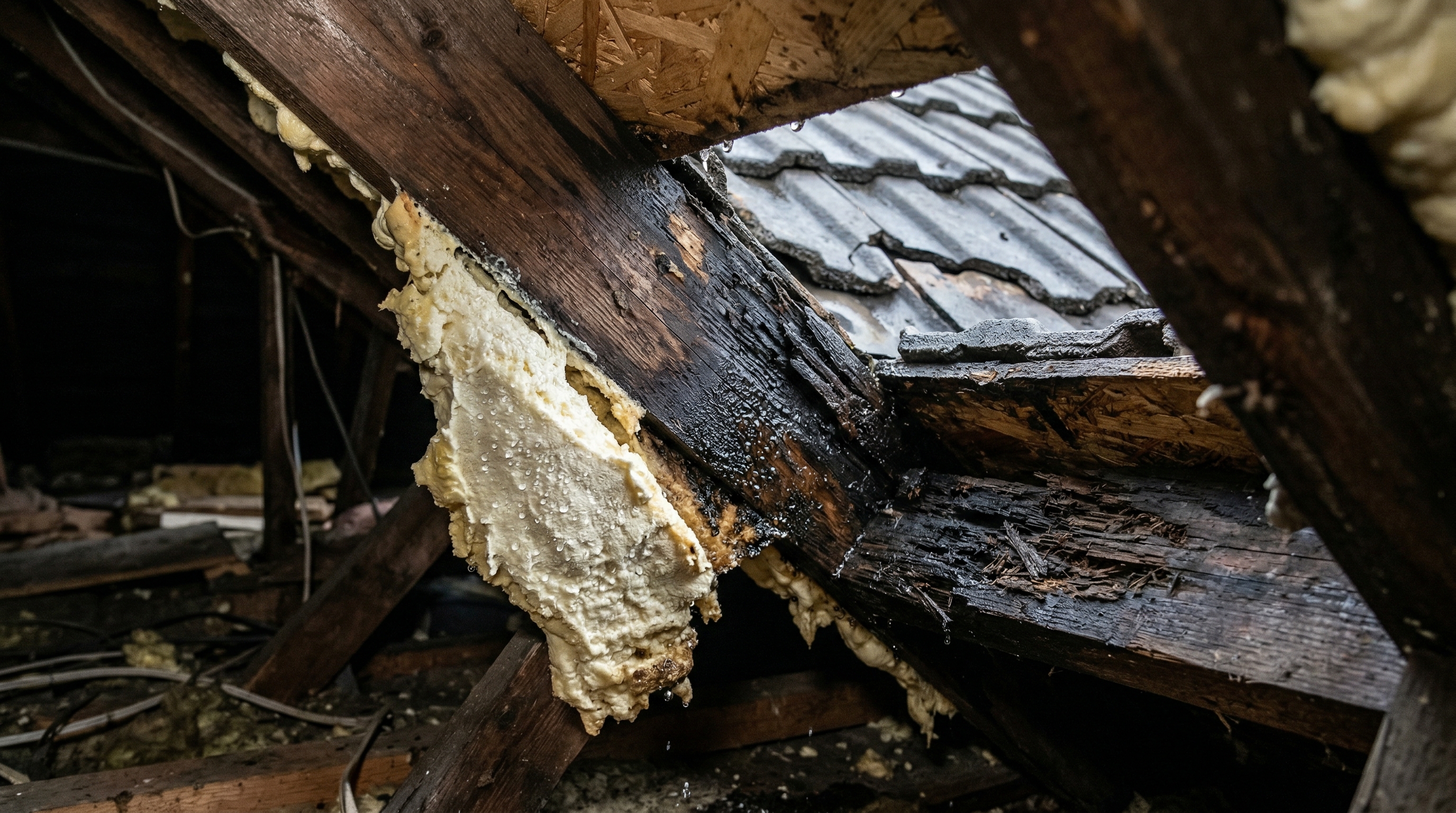
When warm, moist air from the house rises into the loft space and meets the cold surface behind the foam, water condenses. It has nowhere to go. Over months and years, that moisture sits against the timber, and the timber starts to rot.
We regularly inspect lofts where the homeowner had no idea there was a problem. They open the loft hatch, see foam, assume everything is fine. Peel the foam back and the rafters underneath are black with damp, soft to the touch in places. In one property in Sheffield last year, the ridge board had deteriorated so badly it needed replacing — a repair that cost more than the original foam installation.
Open-cell foam is worse for this than closed-cell. Open-cell absorbs moisture like a sponge and holds it against the wood. Closed-cell is less absorbent but creates an even more airtight seal, which means any moisture that does get trapped has absolutely no way to escape.
Timber damage you cannot see
Spray foam bonds directly to the wood. Once it is on, you cannot see what is happening underneath. Woodworm, rot, splitting, previous botched repairs — all hidden.
This is precisely what concerns RICS surveyors. A surveyor's job is to assess the structural condition of the roof. With spray foam coating every rafter, purlin, and ceiling joist, that assessment is impossible. The surveyor has to downvalue the property or flag it as unmortgageable.
Even when there is no active damage, the inability to inspect the timber is itself the problem. You cannot prove the roof is sound, which means you cannot sell to anyone who needs a mortgage.
Building regulations — most installations do not comply
The majority of spray foam installations in UK homes were carried out without building regulations approval. That is not an exaggeration. The installers either did not apply for approval or told homeowners it was not required.
Building regulations require that any change to the thermal performance or ventilation characteristics of a roof must be approved. Spray foam affects both. Without a completion certificate from your local authority, the work is technically non-compliant.
This creates a second problem on top of the mortgage issue. Even if a lender were willing to consider the property, the lack of building control sign-off gives them another reason to decline.
It voids roof tile warranties
Most roof tile manufacturers specify that their products must be installed with adequate ventilation behind them. Spray foam applied to the underside of tiles or the sarking felt breaches those warranty conditions.
If tiles crack or fail and you make a warranty claim, the manufacturer is within their rights to refuse. We have seen this happen twice in the last twelve months — homeowners with relatively new roofs who could not claim because the foam installation invalidated the warranty.
Removal is expensive but it is the only real fix
There is no way to make spray foam acceptable to mortgage lenders without removing it. No coating, no partial removal, no clever workaround. It has to come off completely.
Removal costs vary depending on property size and foam type:
| Property type | Typical cost | Timeframe |
|---|---|---|
| 1-2 bed terrace | £1,500 – £3,000 | 1-2 days |
| 3 bed semi-detached | £3,000 – £5,500 | 2-3 days |
| 4+ bed detached | £5,500 – £10,000+ | 3-5 days |
Closed-cell foam costs more to remove because it is denser and bonds more aggressively to the timber. If the timber underneath has been damaged by moisture, you are looking at additional remediation costs on top.
The good news — and there is some — is that professional removal followed by proper certification restores your property to full mortgageability. Every mainstream lender will reconsider once the foam is gone and an independent certificate confirms the timbers are sound.
Why our certificates are different: We are the only spray foam removal service in the UK where every removal is independently signed off by a RICS surveyor. Other companies issue their own certificates — essentially marking their own homework. Our independent RICS surveyor verification gives mortgage lenders the confidence they need. It is the difference between a certificate that might be questioned and one that is trusted first time.
What to do if you have spray foam insulation
If you are not planning to sell or remortgage any time soon, the foam is not an emergency. But it is worth getting a professional assessment so you know what you are dealing with — particularly around condensation and timber condition.
If you are selling, remortgaging, or facing a mortgage decline, you need the foam removed. The process is:
- 1. Get a free loft assessment — We will inspect your loft, identify the foam type, check for timber damage, and give you an honest picture of what removal involves.
- 2. Receive a fixed-price quote — No surprises. The price we quote is the price you pay.
- 3. Professional removal — Our teams remove the foam completely, inspect the timbers, and treat any issues found.
- 4. Independent RICS surveyor sign-off — An independent RICS surveyor inspects the completed work and signs off your certificate. This is not something we issue ourselves.
- 5. Mortgage proceeds — Submit the certificate to your lender. Revaluation survey arranged. Mortgage approved.
Get a free spray foam assessment
Find out what type of foam you have, whether your timbers are affected, and what removal would cost. No obligation.
Get Free QuotesFrequently asked questions
Is spray foam insulation always a problem?
From a mortgage perspective, yes. Regardless of the foam type, age, or condition, mainstream UK lenders treat it as a material defect. Even if the foam is in perfect condition and your roof timbers are fine, the surveyor cannot confirm that without removing the foam first.
Can I remove spray foam myself?
Technically, you could attempt it. Practically, it is a bad idea. The foam is bonded to your timber at a molecular level. Removing it without damaging the rafters requires specialist tools and experience. More importantly, no mortgage lender will accept a DIY removal — you need a professional certificate, and no certifier will sign off work they did not oversee.
Will spray foam problems get worse over time?
The condensation and moisture issues tend to get progressively worse. The foam itself does not improve with age. As timber degrades, the cost and complexity of removal increases because you end up needing timber remediation as well. If you know you have spray foam, sooner is better than later.
My spray foam was installed by a reputable company with a guarantee. Does that help?
Not with mortgage lenders, no. The installer's guarantee covers their workmanship, not the impact on your property's mortgageability. We have spoken to homeowners with 25-year guarantees from well-known firms who still cannot sell their homes. The guarantee and the mortgage problem are two separate issues.