
How do I know if I have spray foam insulation, and what does it look like?
By Jake Harber, spray foam removal adviserUpdated
Short answer
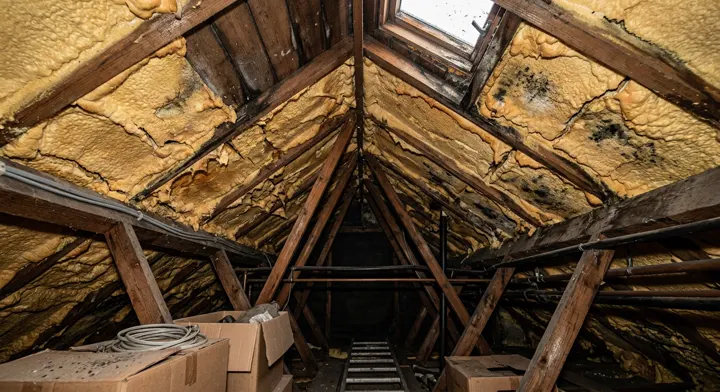
Go up into the loft with a torch and look up at the sloping roof, not down at the floor. The government’s October 2026 paper describes spray foam as “a type of liquid insulation that expands and sets to create a firmer insulation layer”. In a loft it is sprayed onto the underside of the roof, between the sloping timbers (the rafters) and often over them.
The Property Care Association says it forms “a thick, continuous layer that completely obscures the underlying roof structure”, including the rafters. So the clearest sign is what you cannot see: instead of rows of timber with roofing felt or the backs of tiles between them, there is one rough, solid surface of foam. Because it is sprayed on and expands as it sets, the surface is usually uneven rather than flat.
What it is not
- Loft insulation on the floor. Rolls of mineral wool laid between the ceiling joists are the traditional way to insulate a loft. RICS calls this a “cold roof”; spray foam on the roof slope makes a “warm roof”.
- Rigid insulation boards. Foil-faced or foam boards cut to fit between the rafters can look similar from a distance, but they have flat faces and straight cut edges.
- Foam used to hold tiles on. RICS notes that on some old roofs foam was applied to glue the tiles together as a cheaper alternative to re-roofing, not to insulate, and that these roofs are often already past economic repair.
If anything about your roof looks different from this, or you are not sure, take photographs and ask. A removal company or surveyor can usually tell a lot from photographs.
There are two main types, and they look and feel different. The PCA singles out closed-cell foam as the type most likely to form a barrier that traps moisture in the roof, and the two types are removed differently, so it is worth knowing which you have.
| Feature | Open-cell | Closed-cell |
|---|---|---|
| Feel | Soft, light and sponge-like; can be compressed by hand | Rigid and dense; hard to the touch |
| Colour | Often a lighter yellow | Often cream or tan |
| Moisture | Can hold moisture against the timbers if the roof leaks or is poorly ventilated | Can form a barrier that traps moisture in the roof |
| Removal | Usually quicker to strip | Bonds hard to timber, felt and tiles; slower to remove |
Colour varies between products, so treat it as a clue, not a test. You do not need to press, cut or pick at the foam to find out. The type is usually named in the installation paperwork, and a surveyor or removal company can usually tell from photographs. More on each: open-cell spray foam and closed-cell spray foam.
The RICS consumer guide says spray foam “can be applied to roof spaces, walls and floors”. In UK lofts it is usually found on the underside of the roof slope, and foam on the loft floor is uncommon. Places that are easy to miss:
- Rooms in the roof. In dormer and chalet bungalows much of the roof is behind bedroom walls. Look through any eaves cupboard doors or small access hatches.
- Boarded lofts. Check around the edges, at the eaves and behind any stored boxes, where the roof slope meets the floor.
- Walls. Foam injected into cavity walls cannot be seen from inside or out. The paperwork, or a surveyor, is the only reliable way to know. See cavity wall spray foam.
- Extensions and outbuildings. A separate roof, such as a garage or extension, may have been treated even if the main loft was not.
Spray foam that was part of a new build or a designed loft conversion is a different case. The joint industry Spray Foam Customer Guidance says that where foam was included in the construction of a new build, the necessary assessments should have been carried out and “the spray foam should stay in situ”. Most of the problems this site covers concern foam added to an existing roof later.
If foam was installed while you owned the home, you should have been given documents. RICS recommends keeping the installation contract, the relevant calculations, the works carried out to the roof, any guarantee or warranty, and any independent test certificate, for example a BBA or Kiwa certificate. The joint industry guidance describes a full handover pack as including:
- a pre-installation evaluation of the roof;
- a hygrothermal evaluation (a check of the moisture risk);
- a copy of the BBA or Kiwa third-party accreditation;
- the installer’s details and credentials, with copies of guarantees or warranties.
Other places to look:
- Government scheme records. The government paper says installations under government schemes since 2020 must be by TrustMark-registered installers, and your paperwork names the installer and scheme provider. You can search for the business on TrustMark’s Find a Business page.
- The papers from when you bought the house. Your survey report, the mortgage valuation and the seller’s replies to your solicitor’s enquiries may mention roof insulation.
- Your energy performance certificate. The EPC register includes a short description of how the roof is insulated. It is a prompt to ask questions, not proof either way.
If you have no paperwork, the government paper says the installer or manufacturer “should be able to provide it retrospectively.” If you are buying, ask the seller for all of it: see buying a house with spray foam.
The government paper says “only specialist surveyors experienced in spray foam application can tell you if the foam should be removed”. It points to the Property Care Association’s find a specialist tool, which lists its spray foam assessors, and says your surveyor should be familiar with the Spray Foam Insulation Inspection Protocol (March 2023).
A specialist will usually look at:
- 1How much of the roof structure can be seen at all
- 2Whether the foam looks open-cell or closed-cell, and how well it is bonded
- 3What the foam was sprayed onto: felt, a breathable membrane, or the tiles themselves
- 4Whether the roof is still ventilated at the eaves and ridge
- 5Moisture readings in any timber that can be reached
- 6The paperwork: contract, product certificate, guarantee and photographs
Any opening up of the foam, such as taking a moisture reading from the timber behind it, is a job for the surveyor, not for you. Our guide to RICS surveys and spray foam explains the levels of survey, and our sister service National Spray Foam Advice can arrange a specialist survey.
Look, photograph, but do not disturb it
Do not cut, scrape or pull foam away to look behind it. It creates dust, can damage the felt and timber, and leaves no record a lender or surveyor can rely on.
Be careful in the loft generally: stand on joists or boards, not between them, and use a torch rather than any naked flame. RICS describes polyurethane spray foam as a combustible material, so keep heat sources well away from it.
If your worry is health rather than the building, read is spray foam insulation safe? And if you are tempted to take it out yourself, read why DIY spray foam removal goes wrong first.
Do not panic, and do not book removal straight away. The Insulation Manufacturers Association says that in most cases spray foam “is safe and rarely needs to be removed if it has been installed correctly”. It also matters when you come to sell or remortgage, because the timbers are hidden and some lenders decline these homes.
- Gather the paperwork listed above, and ask the installer or manufacturer for anything missing.
- Get advice from a specialist surveyor before you decide anything, as the government paper advises.
- If you are selling or remortgaging, tell your lender or broker early and ask what they need in writing. See which mortgage lenders accept spray foam and selling a house with spray foam insulation.
- If removal is recommended, compare quotes. It typically costs £50–£80 per m², about £3,000–£8,500 for most lofts: see the removal cost guide and certificates after removal.
- Ignore cold calls. The government paper notes an increase in cold calls offering to remove spray foam, and says to report them to Trading Standards.
For the problems spray foam can cause, and the signs that it already is, read spray foam insulation problems.
What does spray foam insulation look like?
In a loft it is a solid, uneven layer of foam sprayed onto the underside of the roof, between and often over the rafters. It hides the timber and the felt or tiles behind it. Open-cell foam is soft and sponge-like; closed-cell is rigid and hard.
How do I know if I have spray foam insulation?
Look up at the underside of the roof in your loft. The government says you can find out by looking for a solid layer of foam across the underside of your roof. If you cannot see into the roof, check your installation paperwork, or ask a specialist surveyor.
How can I tell open-cell from closed-cell spray foam?
Open-cell foam is soft and light and gives under pressure; closed-cell foam is rigid and dense. Colour varies between products, so it is only a clue. The installation paperwork usually names the product, and a surveyor or removal company can usually tell from photographs.
Can spray foam be in walls or floors?
Yes. RICS says spray foam can be applied to roof spaces, walls and floors, although in UK lofts it is usually found on the underside of the roof slope. Foam in a cavity wall cannot be seen, so the paperwork or a surveyor is the only reliable way to know.
Should I remove spray foam if I find it?
Not before taking advice. The government paper says to take advice from a specialist surveyor before making any decision, and that removing the foam will not always guarantee a lender will still lend. Correctly installed foam may not need removing.
- Spray foam insulation: Remediation, removal and lending (22 October 2026), Department for Energy Security and Net Zero
- Spray foam insulation: consumer guide, Royal Institution of Chartered Surveyors (RICS)
- Sprayed foam in roofs: advice for homeowners, Property Care Association
- Spray Foam Insulation Inspection Protocol, March 2023, Property Care Association
- Spray Foam Customer Guidance (joint guidance linked from the government paper), PCA, IMA, RPSA and others
- IMA statement on spray foam, February 2026, Insulation Manufacturers Association
Each source was read on 14 November 2026. Prices are our own editorial figures, not statements by the bodies above.
Talk to someone who knows spray foam
If this guide has left you with questions about your own home, an adviser will call you back and go through them with you.
- Free, and no obligation to book anything
- Plain English, no technical details needed
- Introductions to removal companies or surveyors only if you ask
Or ring 03330 908 569, Monday to Friday, 9am to 5pm.